Wednesday, November 23, 2011

Summary on Grunts to Grammar


Miller, Jeanne.
"From Grunts to Geammar: The Evolution of Language.
" Odyssey: Adventures to science
Oct. 2009: 34,35,36. Print. 

This week in Humanities, we read an article about the development of grammar.  Grammar is so important to our everyday life.   Could you imagine life without words?  Grammar has developed over millions of years.  The development started when the larynx or voice box moved down deeper in our ancestor’s throats.  There is no way to exactly find out when or where grammar started.  As it says in the article, “Spoken words don’t leave fossils.”  Scientist do have theories.  They have looked at different fossils of our ancestors and from that they analyze which things such as tools may have required advanced communication to make.  The first evidence of what scientists think needed complex communication was bones found in Australia.  Scientists know that early humans must have migrated from Asia.  To get to Australia they had to go at least 45 miles by boat.   Early humans had to build that boat and building that type of boat would have needed verbal communication. Scientists have come to a conclusion that grammar was formed 35-40 thousand years ago.  Before grammar was formed our early ancestors must have had to communicate in some sort way before words where formed.   Scientists think these ways where sounds, hand motions, and even facial expressions. In conclusion, I think grammar is one of the most important things in our everyday lives and we would struggle without it.

Thursday, November 17, 2011

Summary on Taming Fire


Cox, Mary Beth.
"Taming Fire." Odyssey: Adventures in science
Oct. 2009: 29-30

Fire is one of the most important things on Earth.  Fire has helped us in so many ways for example it cooks the food we eat, it keeps us warm, it provides light and so much more. Fire always has occurred naturally in nature for example wild fires.   About 250,000 years ago, prehistoric men started to use fire in their everyday lives to cook food and to see at night so they could stay up latter then sunset. You may wonder why were early humans weren’t using fire before.  They were afraid of it because they had only seen it in nature.   Another reason is they did not know how to make it. Fire has had a big influence on man kind fire let us move to colder parts of the worlds like Europe. In conclusions fire is very important  and It would be hard to live without it but remember as  Mary Beth Cox said “DO NOT play with fire!!!”

Wednesday, November 2, 2011

On Our Own Two Feet

Whitt, Stephen. "On Our Own Two Feet."
Adventures in Science Oct. 2009: 26-28

Through the article I read in humanities this week “On our Own Two Feet” I learned a lot about the species that came before us.  There are so many questions yet to be answered about the human species like how we developed to walk on two feet.  Humans have been walking on two feet for about six million years.  This is unusual because most animals walk on four legs or with their arms and feet.  According to one theory by scientist Owen Lovejoy “we started walking to free up our hands and arms for carrying food to our mates.”  My theory is that humans started to walk up right to see better over tall grass.  Scientists have studied the skulls of Australopithecus afarensis, Homo erectus, and Homo sapiens to see how we evolved over time.   Several changes happened throughout time.  The brain cavity got bigger, the face got flatter, and the spine got straighter and the spinal cord entered to our skull at a different point. In conclusion we have changed a lot in six million years.

Sunday, October 30, 2011

Who's who Among the Early Hominins


Susman, Randall.
"Who's who Among the Early Hominins?"
Obyssey Adventures in Science Oct. 2009:
22-25. Print.

The article explains the evolution of the many different type’s species that came before us,  modern day humans.  According to the article, “early hominians are often called “ape-men” because of the features they share with apes and with human.”  Hominin remains have been found in many different parts of Africa.  The oldest species date back to 7 million years ago.  Some have also been found in Asia and Europe.  We have developed so much in the past 3 million years up to now.  Scientists compare the brain size, jaw, teeth, nose socket, forehead shape, hands, feet, and bone structure. They also look at other things found with the remains such as tools, animal and plant remains, and evidence that they used fire.  The development of the different types of hominin species overlapped depending on where and when they lived but all died out except for humans.  For example we have developed in height.  A female homo floreslensis skeleton found in Indonesia was a very isolated type of species from 94,000 years ago.  It was only 3 feet 6 inches tall.  In Kenya the skeleton remains of a 6 foot tall boy homo erectus were found that are 1.6 million years old.  In the last 20 years, archeologists have found several bones that help us understand evolution better.  In conclusion, I think we have come a long way from African apes to humans in 7 million years.

Wednesday, October 26, 2011

Why We Study Human Origins


Why We Study Human Origins
By Randall Susman
Calliope: Exploring World History

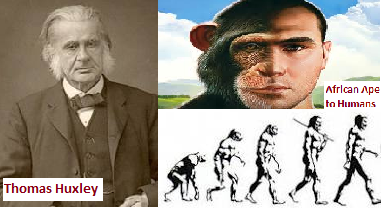
In this article I learned  Evolution is the study of human origin.  It is the study of how we came to be. There are many theories of how we evolved and why.  The main theory of evolution today is that both plants and animals change over time to adapt to their changing environments.  This theory was discovered and introduced by Charles Darwin in the 1800’s.  At that time, there was no evidence to prove this theory true.  In the last 100 years we have found fossils and anatomical evidence that may prove that we could be decadents of apes.  Thomas Huxley believed “anatomically, African apes and humans where similar, more similar in fact then apes where to monkeys”.  Scientists have found several fossils from different periods of time.   These show that different types of ape species existed and changed for example knuckle walkers and bipeds.  This evolution of apes to hominids shows the lead up to who we are today humans.  In conclusion, as we learn more about our ancestors from the past we also can look into our future and predict what we might become as our environment continues to change.


Wednesday, October 19, 2011

Mystery in History Stonehenge


Stonehenge is one of the world’s mysteries.  For a very long time archaeologists have been trying to find out why was Stonehenge was built.  They want to know what Stonehenge used for and who used it.  These questions have yet to be answered.  T here are many theories on Stonehenge but none have been proven true. 

 One of the theories is that Stonehenge was used for telling what time of year.   For example, like a calendar the arrangement of the stones could predict the summer solstice and winter equinox as well as full moons and solar eclipse.  Another theory is that it could be a burial ground since lots of human remains have been found there from all over England.  Other theories could explains these remains such as Stonehenge could have been used for human sacrifice or it could have been a place the ill traveled to for its power to cure them.  Finally, some people believe that Stonehenge was built by aliens because it was built so long ago when they didn’t have the technology we do today to lift such heavy objects or move them such a far distance.  

 In conclusion, even though there are many theories about how and why Stonehenge was built archeologists continue to search for evidence to prove which theory is true.          

Monday, October 3, 2011


Human Ancestor May Put Twist in Origin Story, New Studies Say
Ker Than
Published September 8, 2011

In the last month archeologists have found two million year old fossils of bones. Archeologists do not know what animal the bones belong to but they do know that the unidentified thing has both characteristics of modern day humans and primates aka monkeys.  They think this unknown species could be in one of the stages through which modern day humans evolved.  There are some things they know for sure of the findings, they know that what the human ancestors were a boy about 15 years old and a 30 year old woman.  They also know that the unknown species died because they fell down a deep crevice which is basically a crack in the land.  They know the woman lived longer then the boy.  Archeologists found that the woman’s hands were similar to humans except that the thumb was longer.  Also, from the feet they could tell that could walk standing up but didn’t do it all the time. in conclusion I hope they found out more about this unknown specs and how they lived in the past.